

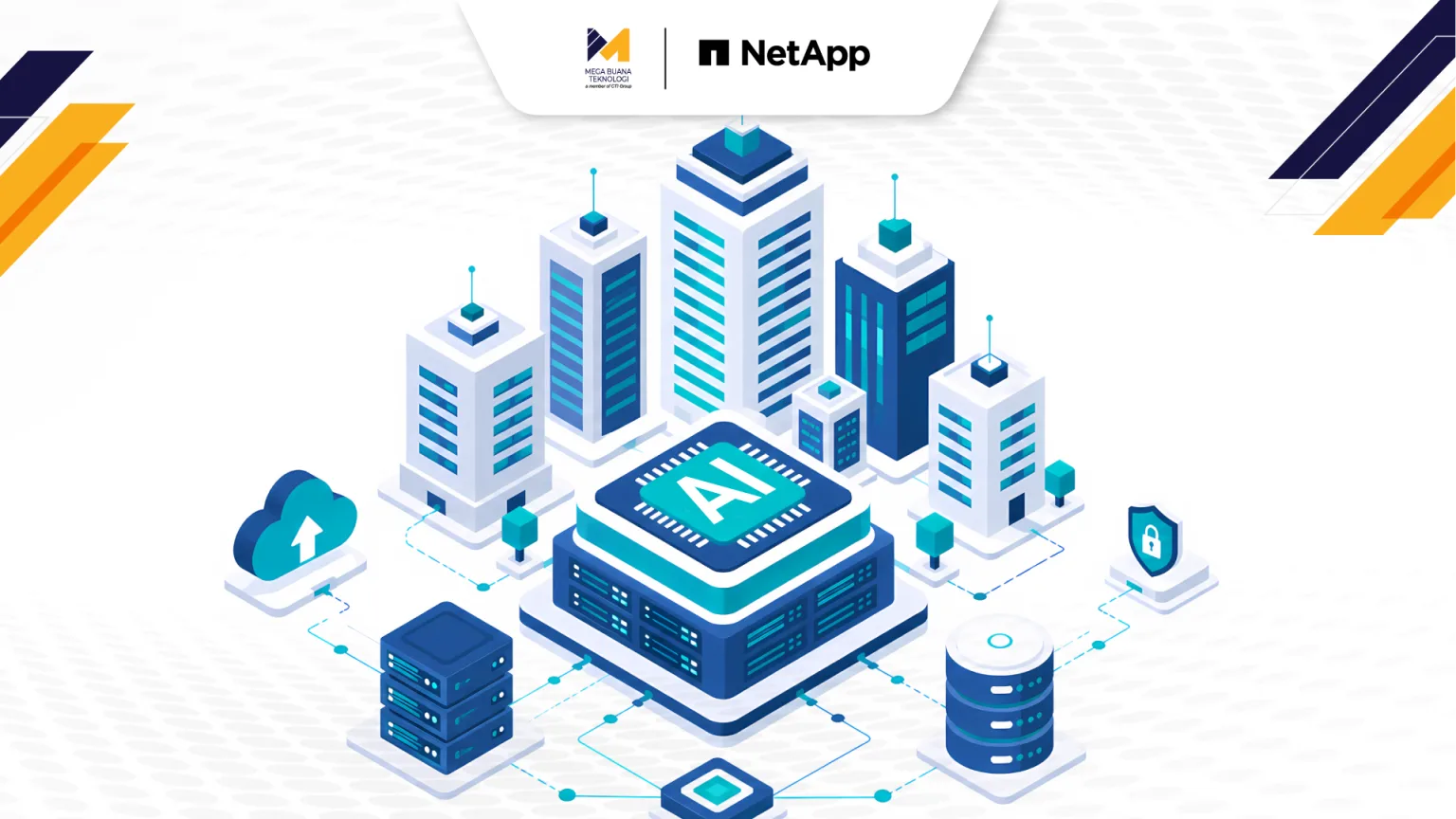
As AI adoption continues to expand, the success of Enterprise AI depends on more than simply choosing the right AI model. Behind every AI application that delivers consistent results is an infrastructure foundation that supports everything from development and deployment to day-to-day operations.
High-quality, well-organized data that can be accessed securely is one of the most critical elements of this foundation. Without it, organizations may struggle to produce AI outputs that are accurate, relevant, and consistent. This makes building an AI-ready data infrastructure an important part of moving AI initiatives from experimentation to broader business adoption.
What Is Enterprise AI?
Enterprise AI refers to the use of artificial intelligence technologies at an organizational scale to support a wide range of business needs, from operations and analytics to decision-making and service development. It encompasses more than AI models, bringing together policies, strategies, data, infrastructure, security, and technologies that enable organizations to use AI securely and sustainably.
Unlike small-scale AI experiments, Enterprise AI needs to support multiple use cases and business teams consistently. As organizations adopt AI for fraud detection, demand forecasting, customer service, knowledge management, and other applications, the variety, volume, and sources of data they need to manage also increase.
This is where infrastructure readiness becomes critical. Without a mature architecture, organizations may struggle to move AI from proof of concept to solutions that can be deployed broadly and deliver tangible business value.
Why Is Enterprise AI Infrastructure Becoming More Important?
As more AI use cases move into production, organizations need infrastructure that can support performance, security, and scalability.
One of the key challenges is data being distributed across different systems and environments. Data silos can make it difficult for teams to discover and prepare relevant information for AI workloads. At the same time, AI workloads require compute, storage, and networking resources that can handle demanding processing requirements at scale.
Organizations also need to consider how AI operates across hybrid environments. Integrating on-premises systems with cloud environments can add complexity to data management, access, security, and governance. Meanwhile, using public AI services without appropriate controls can increase the risk of exposing sensitive business data.
For these reasons, Enterprise AI Infrastructure needs to do more than run AI models. It must also enable organizations to manage, process, and use data securely and efficiently.
What Are the Business Benefits of Enterprise AI?
When supported by the right strategy and infrastructure, Enterprise AI can deliver value across multiple areas of the business.
Drive innovation: AI enables more teams to leverage machine learning and generative AI to solve problems in new ways, develop services, and improve customer experiences.
Strengthen governance: Enterprise-scale AI requires greater visibility and control over data and models. With structured governance, organizations can manage access to sensitive data, monitor AI usage, and build greater trust in AI-generated outputs.
Improve efficiency: Standardizing AI platforms and processes can help reduce duplicated efforts and inefficient resource usage across teams.
Increase productivity: AI can automate routine tasks and help employees access information and insights faster, allowing them to focus more time and resources on higher-value work.
What Are the Key Components of Enterprise AI Infrastructure?
To operate AI consistently at an enterprise scale, organizations need to consider several technology foundations.
Data management and governance
Organizations need data pipelines to support both batch and streaming workloads, along with data catalogs that help teams discover and understand relevant datasets. Governance is also essential to ensure data is accessed and used according to security and compliance requirements.
Compute and model training
AI workloads require computing infrastructure that matches the characteristics of each workload, including GPU resources for certain use cases. Centralized training infrastructure can also help teams collaborate more effectively and reduce duplicated resource usage.
RAG and data retrieval
For generative AI use cases, Retrieval-Augmented Generation (RAG) enables models to use information from an organization’s knowledge base without requiring the model to be retrained from scratch. Data infrastructure that supports indexing, retrieval, and vectorization can help enable these use cases.
LOps and model lifecycle
MLOps help organizations manage the model lifecycle in a more structured way, from development and deployment to monitoring and model updates. A centralized model registry can also support versioning and tracking across different model iterations.
Monitoring and governance
Model performance can change as data patterns or business conditions evolve. Continuous monitoring and evaluation are therefore important to ensure that models remain relevant. For certain use cases, human oversight can also be incorporated as part of the control process.
Read More: Enterprise Data Platform: A Smarter Way to Manage Growing Data Complexity
How Does NetApp AI Data Engine Support AI-Ready Data?
When enterprise data is distributed across multiple sources, the challenge is not simply storing it. Organizations also need to discover, understand, prepare, and govern that data so it can be used effectively by AI workloads.
NetApp AI Data Engine (AIDE) is designed to help organizations make enterprise data easier to discover, understand, and use across AI workloads, including generative AI, RAG, and agentic AI.
AIDE provides metadata catalog and semantic search capabilities to help organizations discover and understand data across their environments. It also supports data preparation and vectorization to help prepare data for AI and semantic retrieval of use cases.
From a governance perspective, AIDE provides data guardrails, monitoring, and audit logging to help organizations maintain greater control over how data is used. This approach allows organizations to gain context and insights from distributed data without having to move all of it into a single location.
NetApp’s focus on AI-driven experiences is also reflected in its customer support ecosystem. In 2026, the NetApp Support Sitereceived the Association of Support Professionals (ASP) Best Support Website Award for the ninth consecutive year. The 2026 recognition highlighted NetApp’s use of AI in areas such as case recommendations and its generative AI capabilities through the Elio chatbot.
These capabilities reflect NetApp’s broader focus on helping organizations make their data more accessible, actionable, and ready for AI, while continuing to improve the experience of managing and supporting enterprise technology.
Build Your Enterprise AI Foundation with MBT
Building secure and scalable Enterprise AI is not simply about choosing the right AI model. Organizations need a data and infrastructure foundation that can support AI from development through production and ongoing operations.
As an enterprise technology partner, Mega Buana Teknologi (MBT), part of CTI Group, helps organizations design and implement AI infrastructure aligned with their business needs, from data platforms to solutions such as NetApp AI Data Engine.
Contact the MBT team to start building an Enterprise AI foundation that is ready to support your business needs.
Author: Wilsa Azmalia Putri
Content Writer CTI Group