
Today’s cyber threat landscape increasingly puts user credentials in the spotlight. For enterprises in financial services, government, and other industries handling sensitive data, a single credential stolen through phishing can become an entry point to critical applications, systems, and organizational information.
This makes it increasingly important for organizations to rethink how user access is managed. Passwords and one-time passwords (OTPs) are still widely used, but both have limitations when facing increasingly sophisticated phishing and social engineering techniques. One approach that can provide stronger protection is the hardware security key, particularly devices that can support both digital authentication and physical access.
Why Are Passwords and OTPs No Longer Enough for Enterprises?
Passwords remain one of the most common authentication methods, but they are also among the credentials most frequently targeted by attackers. Credentials can be stolen through phishing, credential stuffing, brute-force attacks, or data breaches. Even when organizations add OTPs as an additional security layer, the risk does not disappear entirely.
SMS-based OTPs, for example, can be exposed to risks such as SIM swapping. Meanwhile, manually entered OTPs can still be targeted by phishing or adversary-in-the-middle (AiTM) attacks, where attackers attempt to capture authentication information in real time.
The fundamental issue is that passwords and OTPs still depend on information that users need to know, receive, or enter. If that information is successfully manipulated or stolen, attackers may be able to use it to impersonate a legitimate user.
A hardware security key takes a different approach. Instead of relying solely on something the user knows, the device uses cryptographic credentials stored on the hardware itself. With FIDO2/WebAuthn, the authentication process is also tied to the legitimate website or service origin. This means that when a user is directed to a phishing site, the security key will not provide a valid authentication response for that domain.
The result is phishing-resistant authentication that provides stronger protection than password- and OTP-based authentication alone.
How Does a Hardware Security Key Strengthen Digital Authentication?
Simply put, a security key is a physical device used to prove that a user possesses an authenticator registered with a particular service.
In a passwordless scenario, users do not need to enter a password every time they log in. A security key can be used through USB or NFC, followed by a user confirmation on the device to complete authentication.
Behind this simple interaction, the device uses public-key cryptography for verification. The private key remains securely stored within the authenticator and does not need to be sent to the website or application. During login, the system receives cryptographic proof that can be verified using the public key previously registered with the service.
This approach makes credentials significantly harder to steal and reuse remotely. For enterprises, the benefit goes beyond securing individual logins. It also provides a foundation for more consistent passwordless authentication across applications and services that support FIDO2/WebAuthn.
Dual Access: One Security Key for Digital and Physical Access
In enterprise environments, digital security and physical access are often managed as separate systems. Employees may use a security key or password to access laptops and cloud applications while still requiring a separate access card to enter an office, server room, or restricted area.
This fragmented approach increases the number of devices users need to carry while also adding complexity to access credential management.
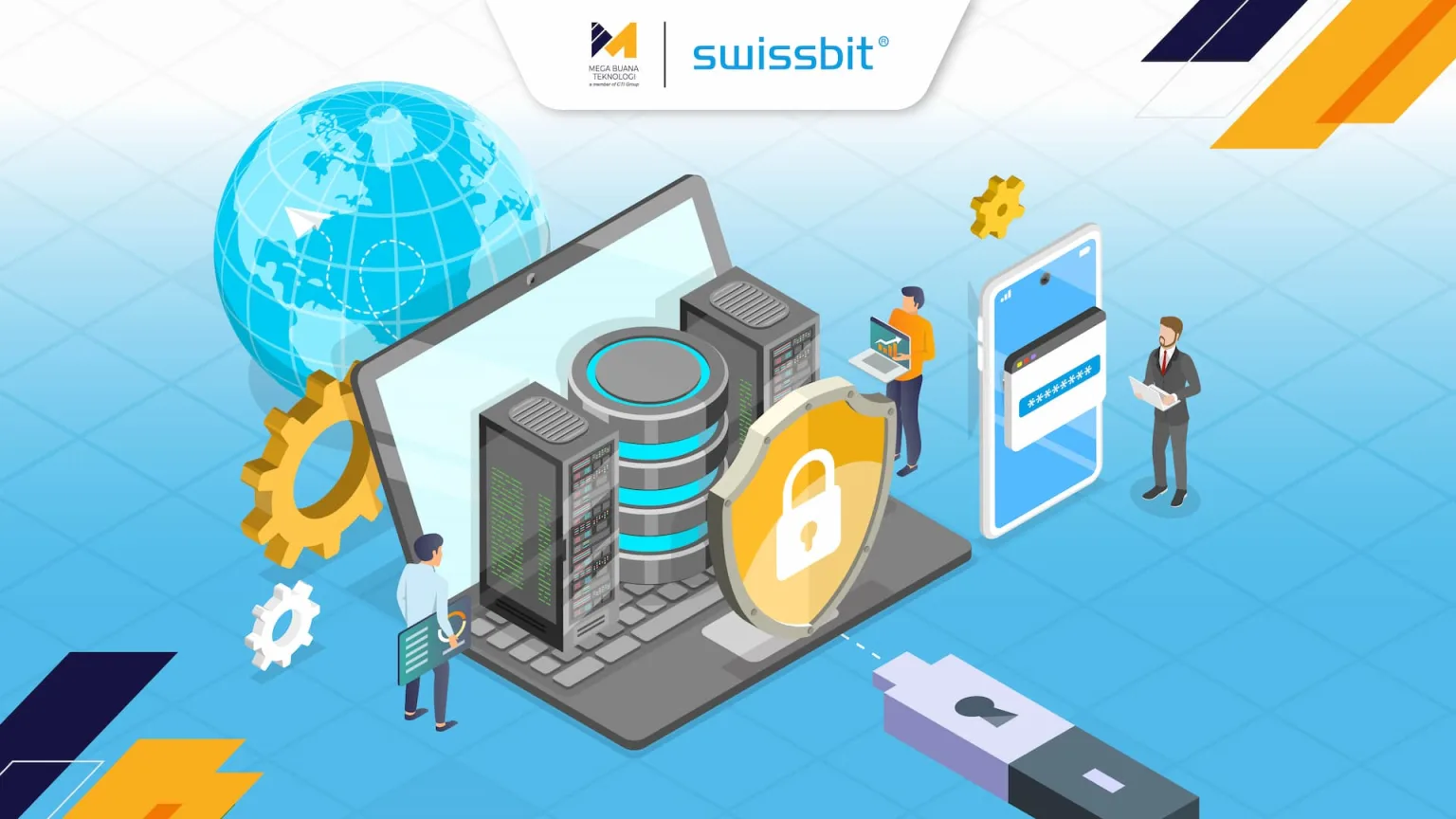
A dual access security key offers a more integrated approach. A single device can be used for digital authentication through USB or NFC while also supporting physical access through contactless technologies such as MIFARE DESFire EV3.
For users, this approach means one device can support more of their everyday access requirements. For organizations, it can help simplify credential management and create opportunities to integrate identity management with physical access control.
Of course, monitoring and policy enforcement still depend on the access control systems and identity platforms used by the organization. However, combining digital and physical credentials within a single hardware device can help reduce fragmentation in access management.
Best Practices for Implementing FIDO2-Based Passwordless Authentication
Moving toward passwordless authentication needs to be carefully planned so that stronger security does not create additional friction for users or IT teams.
First, take a phased approach to deployment. Organizations can start with users who have access to the most sensitive resources, such as administrators, finance teams, or privileged users, before expanding the implementation across the wider workforce.
Second, prepare a backup security key. Losing a primary device should not leave users locked out of all their systems. A backup key can be registered in advance and stored according to the organization’s security policies.
Third, consider using Enterprise Attestation when the organization needs to identify approved authenticators and enforce policies based on those devices. This capability can help enterprises maintain greater control over which hardware authenticators are used within their environment.
Finally, do not overlook lifecycle management. Security keys need to be managed throughout their lifecycle, from provisioning and deployment to firmware updates, replacement, and decommissioning when a device is no longer in use.
Swissbit iShield Key 2: Key Features for Enterprise Security
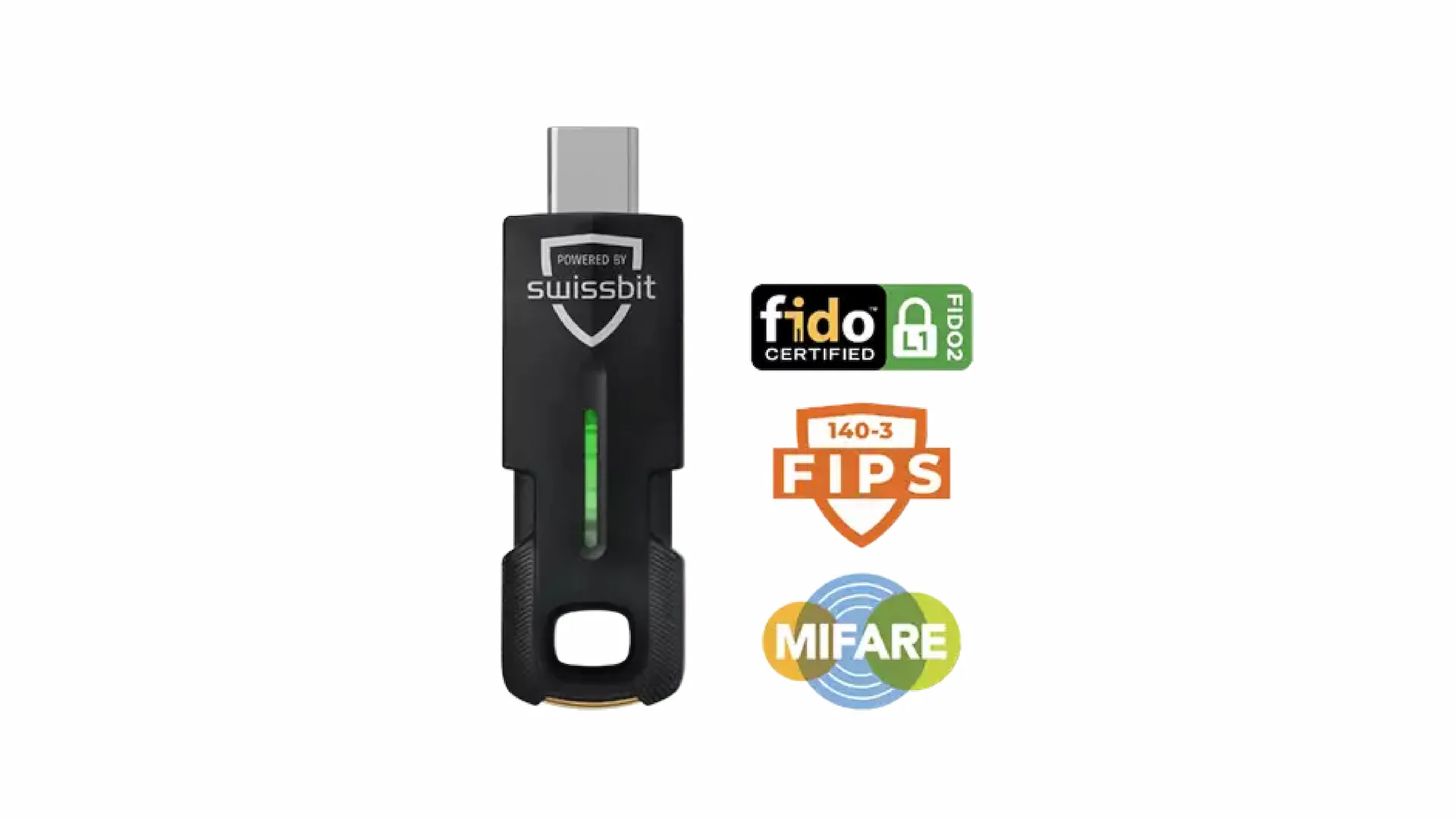
For organizations looking for a hardware security key with broader capabilities, the Swissbit iShieldKey 2 combines multiple digital authentication and physical access functions in a single device.
One of its key advantages is support for up to 300 passkeys in a single security key. This allows one device to be used across multiple services that support FIDO2/WebAuthn without requiring users to switch between different devices for each account.
From an authentication perspective, iShield Key 2 supports FIDO2/WebAuthn, passkeys, TOTP, HOTP, and PIV. Swissbit also offers a variant with FIPS 140-3 Level 3 certification, providing an option for organizations that require a security-certified authenticator for environments with demanding security and compliance requirements.
For physical access requirements, the MIFARE variant combines a FIDO security key with support for MIFARE DESFire EV3. Swissbit positions this combination as an approach to integrating digital authentication and physical access within a single device.
Device management is supported by iShield Key Manager, which helps IT teams configure and manage various authentication functions on compatible devices. Remote firmware update support also helps organizations keep their devices up to date without relying entirely on manual processes for each security key. With these capabilities combined, iShield Key 2 can serve not only as a security key for login, but also as part of a more integrated enterprise access management strategy.
Strengthen IT Security and Efficiency with a Hardware Security Key
Beyond strengthening authentication security, passwordless authentication can also help organizations reduce their reliance on passwords and repetitive account recovery processes. For enterprises with large user populations, simplifying authentication can reduce everyday friction while providing a more consistent login experience.
From a security governance perspective, hardware security keys can also support organizations in strengthening authentication controls and aligning with relevant security and compliance frameworks. For highly regulated industries, using authenticators backed by relevant standards and certifications can contribute to a stronger security posture while supporting audit requirements.
Ultimately, enterprise security is not only about how effectively an organization detects threats. It also depends on how effectively it ensures that only the right users and devices can access critical assets.
Strengthen Enterprise Security with MBT and Swissbit
As threats targeting user credentials continue to evolve, relying on passwords as the primary line of defense is becoming increasingly risky. Hardware security keys offer a stronger approach by combining cryptographic authentication, phishing resistance, and in specific implementations, physical access within a single device.
As an authorized Swissbit partner in Indonesia, Mega Buana Teknologi (MBT), part of CTI Group, can help organizations design a hardware security key implementation strategy aligned with their requirements, from needs assessment and Swissbit iShield Key 2 procurement to integration and ongoing management support.
Contact the MBT team to explore how hardware security keys can help strengthen digital authentication and physical access across your enterprise environment.
Author: Wilsa Azmalia Putri
Content Writer CTI Group